Gyroplane Pilot/Instructor

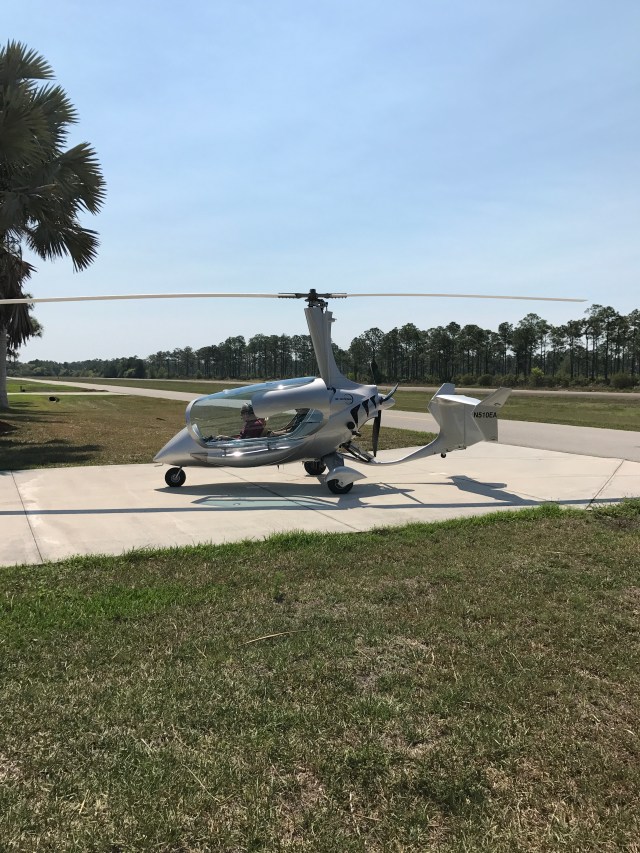
This past week, I had the opportunity to train in Sebring, FL in this:

IMG_0123

This is an ELA Eclipse-10 gyroplane.  It is owned by an aspiring-pilot here in North Carolina (edit: he sold it the week after I trained in it, but is ordering another one in green) but it is still with Pictaio Aerospace in Sebring since he doesn’t have a license to fly it.  I spent a week there first learning how to fly gyroplanes and then learning how to instruct in them.  It was a very intense week but I was endorsed as a gyroplane pilot on Wednesday and as a gyroplane sport instructor on Friday.  These aircraft are amazing! I wrote about their possibilities in the mission field a year or so ago, and am only more convinced today.
IMG_0106

Here is a picture of another Eclipse driving up a driveway at an airpark in Florida.  As part of my training, I transported my instructor (Chris Lord) to several different airports and airparks for demonstration rides with prospective customers and training with students.  We cruised at approximately 115-120 mph without the typical turbulence felt in a light airplane on a hot, Florida day.  These gyroplanes are very stable and can take-off and land in very short distances (landings are almost 0 distance)!

I am very excited to see where the gyroplane opportunity leads for myself and Great Commission Aviation.  I only see promise from here!


We Need An Airplane!

Since becoming a CFI in October of 2016, I have been gaining experience in instruction with several students.  One of these students, Stephen, is a graduate of our Great Commission Aviation ground school and is planning on, one day, utilizing aviation in his vocational ministry.

We have several other prospects for flight aptitude training, and would love to market for more, but we need an airplane!  As we have explained before, Great Commission Aviation was created to train future “preacher/pilots” in the micro-aviation world.  This includes both flight training and maintenance training on these type of aircraft.  Our favorite is the Zenith 750, available as both a kit aircraft assembled in the field, or a factory-assembled aircraft.  However, these aircraft cost approximately $50,000 unassembled or double that for a completed aircraft.  We are asking that everyone give a tax-deductible gift to the acquisition of one of these aircraft and share this post with anyone who may have an interest in assisting this aviation ministry.  Thanks for your prayers and financial support!

DONATE NOW!

061

What is a Mission Pilot?

What is a mission pilot?  I have been asked by many people if Liani, the kids and I intend on moving to a remote part of the planet and living the life of the stereotypical missionary pilot.  The answer is “no” but, also, raises the discussion of people not really understanding how aviation can be used outside of the jungle bush-pilot.  Can a pilot be a missionary domestically?  The answer is a resounding “yes!”  I want to describe some of the avenues that have been brought to me as a domestic mission pilot:

  1.  Training – As you all know, I just received my CFI (Flight Instructor) rating.  There were several reasons for me desiring this. I love teaching and one of my spiritual gifts is teaching.  I don’t have to just teach aspiring mission pilots or those exploring that field.  I will also instruct my fellow aviation enthusiasts of all walks of life.  Let me tell you, when another pilot/passenger in a small general aviation aircraft finds out you are an ordained minister with a Seminary degree, A LOT of ministry opportunities occur.  Discussions about God, eternity and life’s struggles are all opened up when you share a small cockpit (and I don’t mean people being scared of the “dangerous” airplanes).
  2. “Discovery” Flights/Sightseeing – I have flown more than a handful of individuals/families who have never been in a small airplane, including foreign missionaries’ children who were here on furlough.  It is a great ministry to bring joy and excitement to peoples’ lives and give them an experience they will never forget.  Remember, many of these families, especially the missionary kids, do not have the expendable income just to do “fun” stuff.
  3. Mission Trips/Disaster Relief – Last year, I was given the opportunity to fly a Piper Aztec twin-engine airplane to Eleuthera, The Bahamas on a mission trip.  We packed the plane with ceiling fans, lawn chairs, and dog food.  Why?  The Bahamians have to spend a ridiculously high price for these items due to shipping on a container ship from Florida.  We bring them for the extra price of the duty tax in a quick hour flight from Florida (5 hours from North Carolina).  Our cargo was just a sampling of what the missionaries on Eleuthera were needing at the time.  It changes every time we fly.  Other private pilots have flown hundreds of relief missions to West Virginia during the flooding and to Haiti post-earthquake.  Disaster relief is gearing up again due to the flooding in Louisiana, and now, Hurricane Matthew’s path through the Caribbean.
  4. Civil Air Patrol – Did you know that the US Air Force has a civilian auxiliary; the Civil Air Patrol (CAP)?  CAP has been around since 1941 and is considered a “non-combatant” arm of the Air Force.  We fly the largest collection of Cessna aircraft in the world, including Cessna 172’s, 182’s, and 206’s.  CAP has three primary missions; Cadet Programs, Aerospace Education and Emergency Services.  I am involved in all three to some degree.  As a pilot, I have been certified as a Mission Pilot for Search and Rescue and Disaster Relief.  We are the guys tasked with finding missing aircraft and even missing persons to an extent, such as flood victims or lost hikers.  We fly photography missions documenting storm damage, or man-made damage (i.e., terrorist attacks such as 9/11).  Post Hurricane-Matthew, CAP airplanes took tens of thousands of digital pictures of water levels and flood damage.  I personally flew several of these Aerial Photography missions.

As you can see, mission aviation encompasses so much more than stereotypical “bush” flying.  My family and I have been called to mission aviation, but in a domestic context.  If you would like to join with us in this endeavor, please visit our giving page at https://globalservicenetwork.org/ and search for Jason Wilkinson under GIVE/Find An Associate.

CFI!!!

cfi

It took over an entire month, but I am now officially a Certified Flight Instructor – Airplane.  The test comprised two days, with a six-week break in the middle, and more than 7 hours in length.

I started the exam in August at the Greensboro FSDO (Flight Standards District Office) of the FAA and completed the 4.5 hour oral exam before the Cessna 172RG that I flew over to use for the flight portion was grounded by the FAA aircraft examiners.  The flight school where I rented the airplane had to obtain a “ferry permit”, which is a one-time permit to fly for maintenance, to return the airplane.  That airplane immediately went into an engine overhaul and is still out-of-service until the end of October, at least.  I then could not find another suitable airplane, or suitable weather, for the next 6 weeks!

I was finally able to rent a Piper Arrow from Elon Aviation in Burlington, NC and spend a few hours learning an entirely new airplane before going and finishing the checkride with the FAA.  Luckily, a Piper Arrow flies and looks very similar to the Piper Warriors I had been flying with the flying club, just with a retractable landing gear and a constant-speed propeller.

On October 3, the weather was great and I flew the Arrow back to Greensboro (only a 20 mile flight from Burlington) and spent the final 3 hours of the exam preparing to fly and actually flying.

The flying portion of the flight instructor exam is to either observe and critique the student (which just happens to be the FAA Examiner) or to demonstrate private pilot and commercial pilot maneuvers.  I won’t go into the minutia but it is an intense couple of hours that go by really fast!  It is a progressive test in that as long as the examiner doesn’t stop you to say you did not meet standards (i.e., you have failed), then you are still passing.  When I landed back in Greensboro, I knew that as long as I could taxi back to the general aviation area, then I had passed.  It was a great feeling but I was too numb for it to really sink in until today.

What’s next?  I have the opportunity to fly several mission-style flights domestically, especially through Civil Air Patrol, with Hurricane Matthew headed this way.  In addition, I have several student, both missionary and just aspiring pilots, looking to start training ASAP.  Finally, I still have to add the Instrument Add-on to my instructor certificate so I can teach people not just to fly, but to fly in the clouds!  Stay tuned for more excitement!

Spin Training! And other items…

It has been awhile since I have posted an update, but rest assured, we have been busy!  I have been spending my time preparing for the Certificated Flight Instructor (CFI) Checkride with the FAA.  This practical exam must be performed with the FAA and is expected to last 6-8 hours!  This is the license to teach so the FAA takes it very seriously.

In preparation, I am required to become endorsed in spin awareness and recovery.  I was a little apprehensive about the whole ordeal and then started having fun, so forgot to take any pictures of the flying.  Here is a similar pic I found on Google (yes, you are pointed straight at the ground during this maneuver):

sp14
Courtesy http://www.sheltonaviationinc.com

You can find videos of spin training on YouTube so I won’t bore you with the details, but it is definitely an “unusual attitude.”

In addition, we have made several contacts over the past few months with other missionary pilots, including a missionary who served in the Philippines flying an ultralight.  We also spoke with another group of missionary pilots wanting to teach the locals of Papua New Guinea how to build and fly Just SuperSTOLs.  Finally, we have been assisting and visiting with the guys at Missionary Air Group in Burlington, NC (www.missionaryairgroup.org).  They are starting a training program in their newly refurbished Cessna 172M and are in the process of moving their staff and families to Burlington.

I am looking at scheduling the CFI Checkride for late July and then will immediately be available for training other potential missionary pilots.   Pray for us and wish us luck!

On a related note, we will start heavy fundraising for family financial support and operational support soon.  Please start praying about how God is asking you to help!

Commercial Checkride Passed!

Well, after 269.4 hours of flying experience, I can be paid as a pilot.  I officially have a Commercial Pilots License.  This is the final chapter before becoming an instructor.

The checkride had already been delayed a few weeks earlier due to bad weather and snow.  The commercial rating is not an instrument rating so we needed good visibility to complete the test.  Saturday was forecast to be bad to worsening weather but the examiner called me at 5AM to let me know that the weather was holding off a little bit and if I could start early, he could too.  I picked up the airplane, a Cessna 172RG (has a retractable landing gear and a constant-speed propeller) and arrived at Raleigh Executive Jetport (KTTA) at 9AM.  We immediately started on the oral portion of the exam.  This exam covers a lot of the same material as the Private Pilot Rating but in much more detail since this is for the “professional” level.

Satisfied with my answers, the DPE (Designated Pilot Examiner) told me to get the plane ready to fly.  We took off quickly and went through the required maneuvers before the weather worsened.  After completing all of the maneuvers, the final maneuver is the 180 degree power-off spot landing.  This is one of the commercial maneuvers that worries every candidate.  You get one shot to pull the power at the “abeam” point of your landing spot on the runway and then judge the airplane’s glide to land on your “spot.”  You fail the maneuver if you land 1 inch short of your spot or further than 200 feet beyond.  That is not much room on a 6,000 foot runway.  I made the prettiest landing I have ever performed on that maneuver landing within 20 feet of my spot.  The DPE complemented my abilities, I credit luck and the Lord above.

After giving me a temporary certificate, I flew the plane back to North Triangle Aiport (KLHZ) before the weather got nasty for the rest of the weekend.

Meanwhile, while preparing for the Commercial Checkride, I have been able to take up a couple of Great Commission Aviation students for demo flights.  Both Stephen and Patrick have gone up for an hour or so each to see if they actually like flying in little airplanes.  Both had the chance to take the controls for a bit and both seemed to really like the experience.  Now, on for me to finish the CFI and CFII instructor ratings so these guys can start their journey!

IMG_0159
Patrick and the 172RG in which I completed the Commercial Rating.
IMG_0150
Steep turns!
IMG_0144
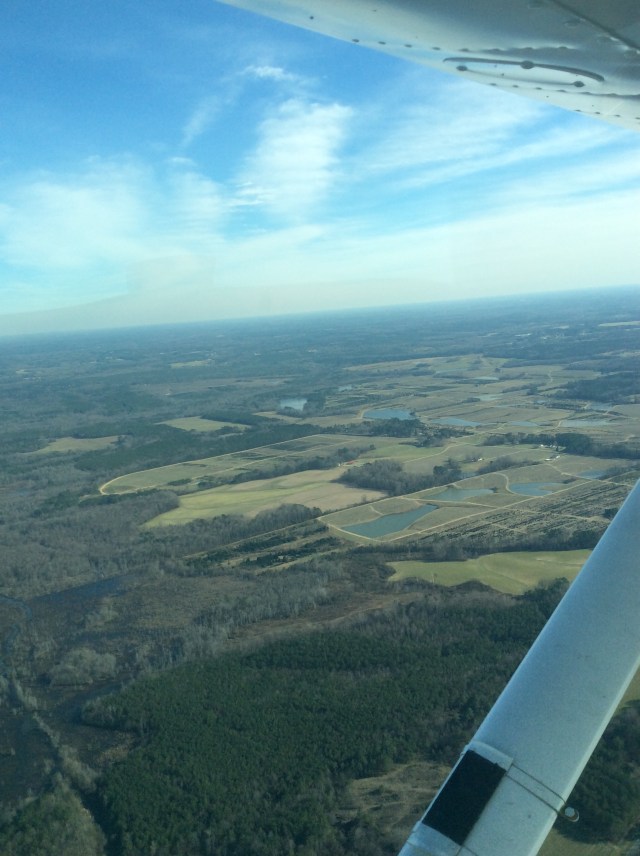
North Carolina landscape.

IMG_0142


Taking Patrick Flying

On January 31, Great Commission’s first ground school student was able to take to the skies with Jason Wilkinson.  The two flew in a Cessna 172RG, which is a retractable gear Cessna 172.  Jason was able to show Patrick private pilot and commercial maneuvers and even let Patrick try his hand at straight and level flight and gentle turns.  The day turned out to have very gusty winds and cut the flight short to only about an hour.  Patrick is excited to get back up in the air and start training as a mission pilot himself.

Spring Ground School and Updates

Our Spring Ground School will begin Thursday, February 4, 2016 at 6PM.  Cost is $95 and the class will be held at the North Triangle Executive Airport Conference Room.  We will meet from 6PM-9PM for 11 weeks.  Send an email if interested in registering.

IMG_0101

Updates:

I have been busy preparing for the Commercial Rating Checkride and will take the Checkride within a couple of weeks.  In order to prepare for the Commercial Rating, I have been training in a Cessna 172RG (Retractable Gear).  This plane is fun to fly and is interesting in that it retracts its landing gear like a wasp.  Here are a couple of generic pics of a 172RG:

Our further plans include attending a 15-day flight instructor training camp during March, visiting Sun-N-Fun again this April and potentially flying to Eleuthera once again later this Spring.

Happy Anniversary!

Reposted from Stephen Merritt, Board Member and Flight Instructor:

At approximately 10:35 in the morning on December 17, 1903, Orville Wright made the first powered, controlled, and sustained flight of a heavier-than-air machine. The flight lasted 12 seconds and covered 120 feet (37 meters). Orville and his brother Wilbur made three more flights that day, the longest of which covered 852 feet (260 meters) in 59 seconds. With this telegram, sent from Kitty Hawk, North Carolina, in the late afternoon of the same day, Orville informed their father of the achievement. The text reads: “Success four flights this morning all against twenty one mile wind started from Level with engine power alone average speed through air thirty one miles longest 57 seconds inform Press home Christmas”. The Wright brothers ran a shop in Dayton, Ohio, where they rented, sold, and manufactured bicycles. Their father, the Most Reverend Milton Wright, was a bishop in the Church of the United Brethren in Christ, whose gift of a toy “helicopter” to his sons in 1878, when Orville was seven years old and Wilbur aged eleven, has been credited with helping to kindle in them their fascination with mechanical flight. The brothers chose Kitty Hawk as the location of the first flight based on information provided by the Weather Bureau in Washington, DC.

Spring Ground School Registration Beginning!

Things have been progressing nicely for the Fall Intro to Mission Aviation Ground School class and it is now time to begin registering for the Spring Semester.  Classes will begin in late January and will last approximately 11 weeks.  Cost is still $99 plus books.  Times will be set closer to class start based on polling of registered students.

So, who should take this class.  Anyone interested in mission aviation, obtaining a private pilots license or just want more information regarding aviation.  We hope to see you there!  Email greatcommissionaviation@gmail.com to register.

IMG_0101